01 — Rules and airspace
What is legal, what is not, and why. Controlled airspace, authorizations, altitude limits, people and property below, and the parts of New York where the answer is simply no. This block is not optional and it is not short.
Home/Training & Programs/Crew training
For roofing & construction companies
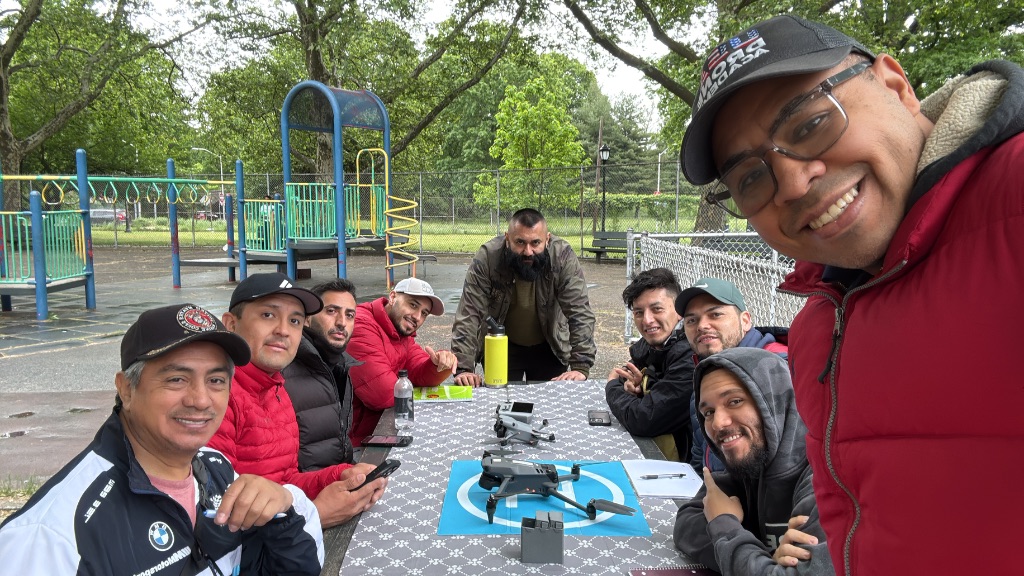
We teach roofing and construction people to document their own work from the air — roofs, progress, site conditions — instead of hiring a drone vendor every time someone needs a photograph. Delivered in English and in Spanish, on your jobsites.
Language
Half the crews working roofs and sites in this city do not learn best in English, and pretending otherwise wastes everybody's day. Every training we run can be delivered in English, in Spanish, or both in the same room — which is often what actually happens.
Written materials, checklists and pre-flight sheets come in the language the crew reads. The person who ends up holding the controller should be the person who understood the briefing.
Why companies do this
It starts reasonably. You book a flight for one roof. Then an adjuster wants photos of a different elevation, a client asks for an update mid-job, and a leak shows up on a building you finished last spring. Each of those becomes another scheduling conversation, another invoice, another day of waiting for files.
Somewhere around the fifth or sixth booking, a foreman says the obvious thing: we could just do this ourselves. Usually they can. What they are missing is not talent — it is a day of structured instruction and a clear idea of what a usable image actually looks like.
That is the whole offer. We are not trying to turn roofers into hobbyists. We are trying to get one or two people on your crew competent enough that the drone stops being a novelty and starts being a tool in the truck.
Foremen, superintendents, estimators, project managers, service techs and owners who are tired of outsourcing the same flight.
Anyone hoping for a certificate in an afternoon. Competence takes flight time, and flight time takes a calendar slot.
None to start. No prior drone experience needed — most crews we train have never flown anything.
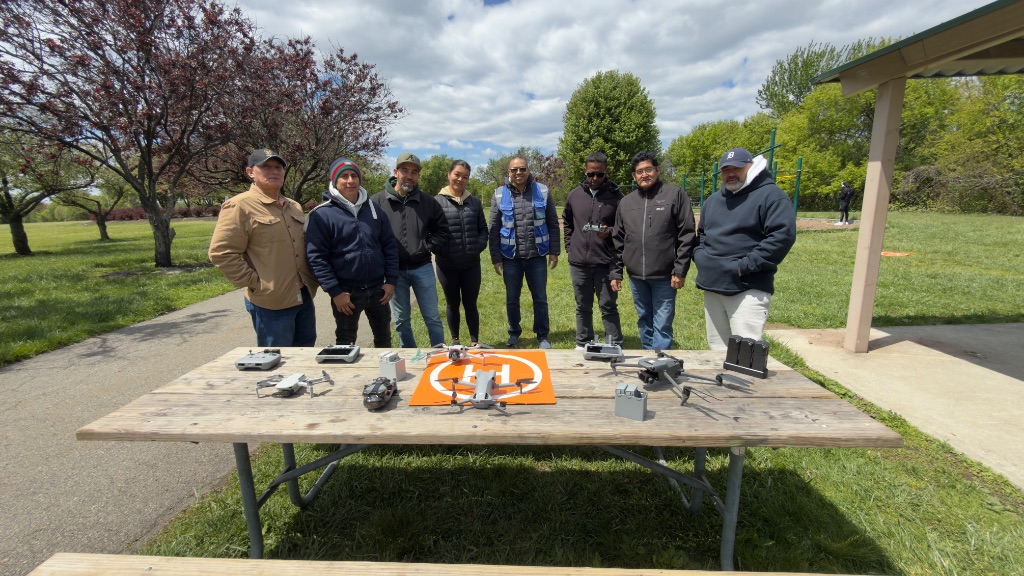
Small groups work best. Two to six people per session keeps everyone on the controls instead of watching.
Straight about the paperwork. Flying a drone for a business in the United States falls under the FAA's small UAS rules and generally requires a Remote Pilot Certificate under Part 107. We prepare your people for the knowledge exam. The FAA sets the requirements and issues the certificate — nobody else can.
The program
Five blocks. The first two are non-negotiable, because a crew that can fly but cannot read airspace is a liability with a camera attached. The rest flexes to what your work looks like.
What is legal, what is not, and why. Controlled airspace, authorizations, altitude limits, people and property below, and the parts of New York where the answer is simply no. This block is not optional and it is not short.
Site survey, weather call, battery management, the checklist that goes on the clipboard. The goal is that your crew stops improvising and starts repeating the same safe sequence on every job.
The core skill for roofing crews. Repeatable flight patterns that capture every plane and every penetration, plus the detail shots an estimator or an adjuster will ask for later. Flat membrane, pitched shingle, slate, tile, standing seam, cornices.
Setting up the same shot from the same position on the same day of the week, so month three lines up with month one. Plus records of existing conditions before a crew touches anything.
Naming, sorting, backing up and handing over. A perfect flight that nobody can find six months later is worth nothing when a dispute lands on your desk.
Study support for crew members who need to sit the FAA remote pilot knowledge exam. Charts, airspace classes, weather, loading, crew resource management. We prepare; the FAA tests.
How it runs
No fixed packages, no per-seat pricing on this page. We look at the crew, the equipment you already own and what you need to document, then propose something concrete.
One day, one site, hands on the controls. Enough to fly safely, capture a roof properly and know when to put it down. The right starting point for most crews.
Several sessions across a season, building from first flight to independent documentation. Usually for companies training more than one crew or adding a dedicated pilot role.
For crews that already fly but have drifted. We watch a real flight, point out what is working against them, and tighten the procedure.
Request crew training
Fill in what you know. If a field does not apply yet, leave it — the first conversation is where the details get sorted out.
Also from Drone Service
Ask us on the first call. Sometimes the honest answer is that your volume does not justify a trained pilot yet, and we will say so before taking your money.